Three months in, The Studio Dispatch has become something dangerously close to a habit. Although it is late, maybe we’re slipping in the opposite direction again… time will tell.
October gave us two milestone work anniversaries and two launches at opposite ends of the technology spectrum: one helping businesses put AI to work, the other helping them access the money they have already earned. Different challenges, same need for planning, great design, and a CMS that’s actually usable.
Here’s what’s been happening in the studio—plus five AI shifts that moved the conversation on again.
Nineteen years, between two very good people
October marked 11 years at Fhoke for Seb and eight for Kasia. That’s 19 years of ideas, launches, problem-solving and knowing exactly where the bodies are buried. Metaphorically speaking, obviously.
Longevity matters in a small studio. It means shared history, hard-earned shorthand and a level of trust that makes ambitious work easier to deliver. Clients feel it too. The people who understand the brief at the start are still there when the work launches, evolves and comes back around for its next chapter.
So, a very happy Fhoke-versary to them both. Mega, to use the official terminology.
AI, minus the usual visual clichés
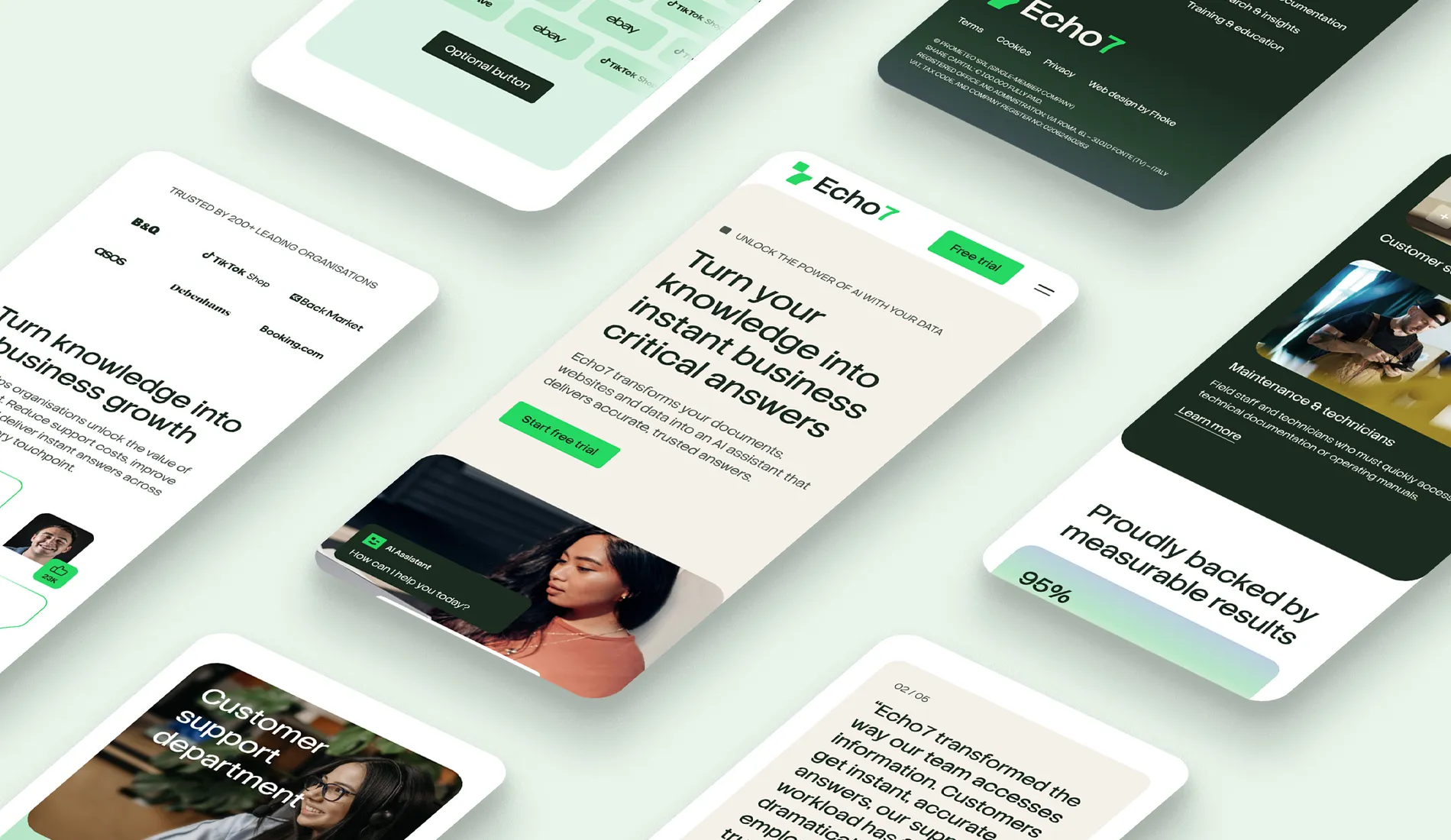
AI businesses have a difficult balancing act. The technology needs to feel advanced without becoming intimidating, and the brand needs to look innovative without reaching automatically for a glowing brain, a robot head or another blue-purple gradient.
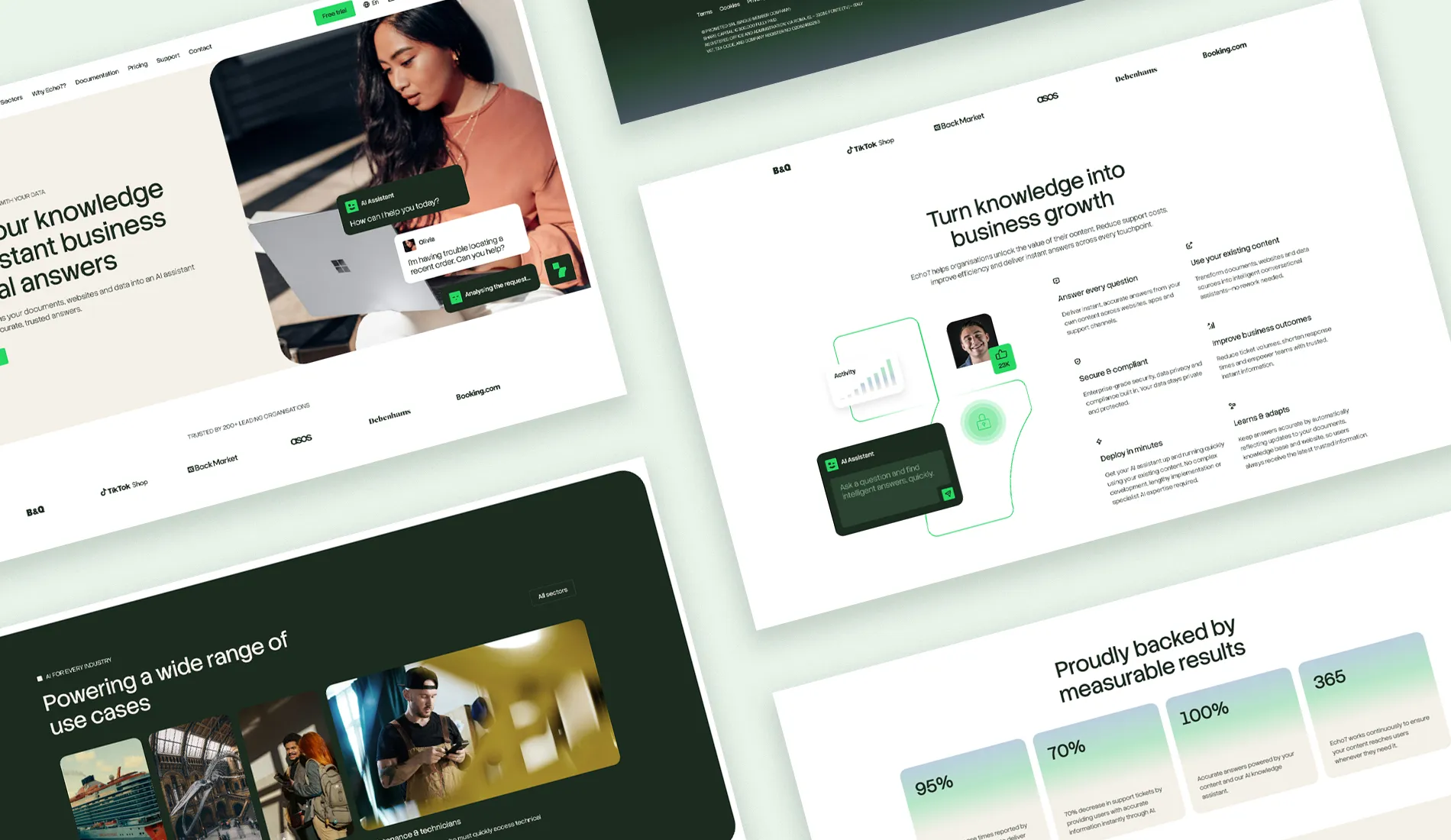
For Echo7, we started with a blank canvas. A bespoke logo, colour palette, typography and illustrated graphics created a confident identity with enough personality to stand apart in a rapidly filling market. Clean layouts, bold type and carefully paced content then made its intelligent assistants, document processing, integrations and automated workflows much easier to understand.
The bespoke WordPress platform is built from reusable content blocks, giving the team room to grow without needing us for every update. We also integrated Echo7’s own plugin, restyled its forms and pricing tables, and embedded an AI Assistant that has learned from the website’s content. Visitors can ask about the platform and get relevant answers there and then—a working demonstration rather than an AI badge stuck in the footer.
We shared more about bringing Echo7’s brand and WordPress website to life, including the useful reminder that even the most advanced technology still needs people to understand it, trust it and feel comfortable using it. Innovation can do plenty. Explaining itself is not always one of those things.
Giving cash flow a visual language
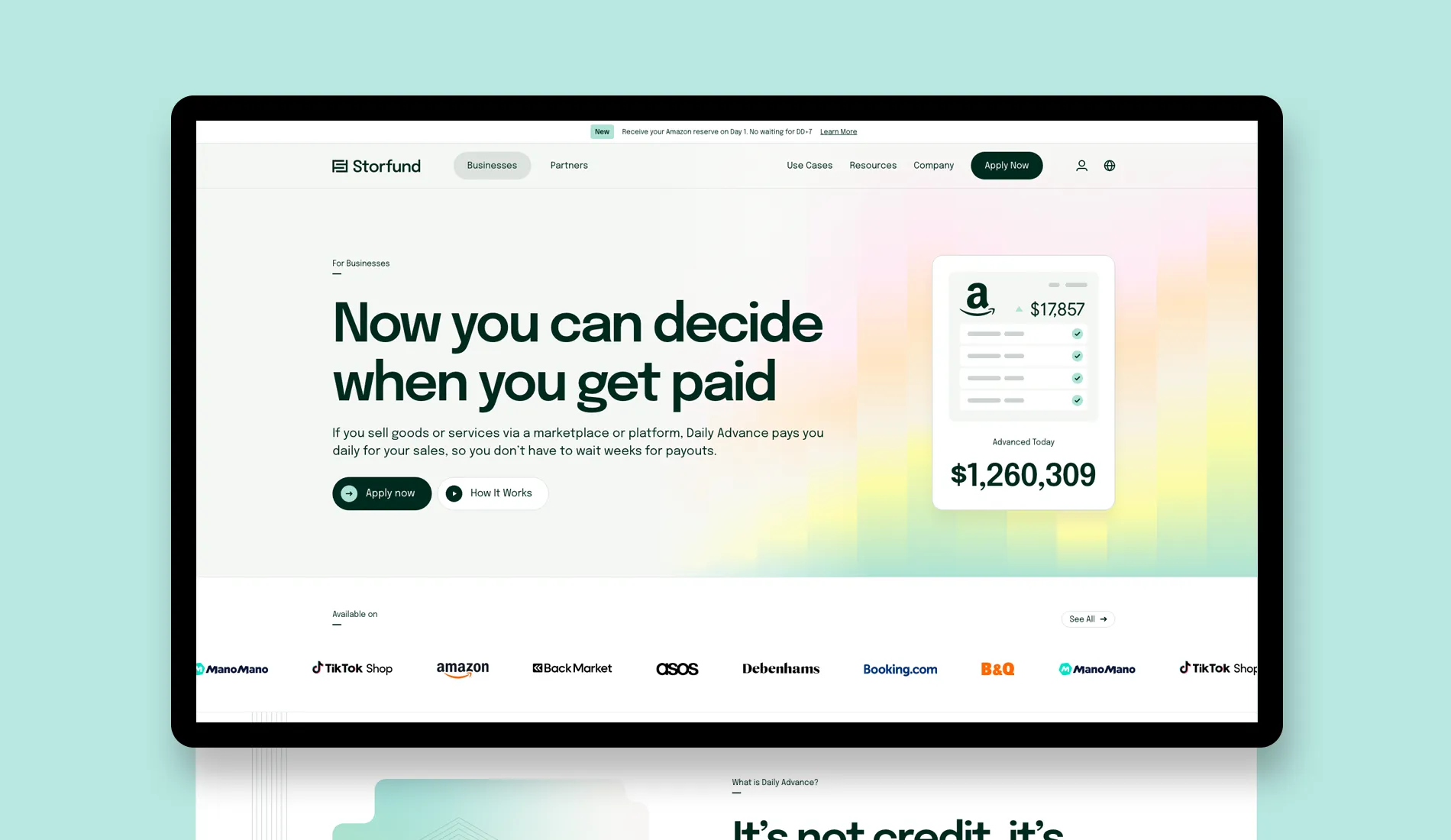
Storfund helps businesses access revenue sooner through its Daily Advance product, while giving platforms a way to offer that service to their customers. The benefit is refreshingly simple: businesses get the money they have earned without waiting weeks for a platform payout. The infrastructure behind it takes a little more explaining.
Our relationship began in 2024, when we rebuilt Storfund’s existing website around a much more usable WordPress setup. This time the brief went further: a complete brand overhaul, a new website experience and a distinctive visual device we called the Liquidity Bars.
The new Storfund brand and WordPress website uses deep green, mint tones, soft gradients and generous typography to balance financial confidence with a more approachable personality. The Liquidity Bars run through headers and page sections, turning the flow of money—and the gaps between earning and being paid—into something recognisable and visual.
Clear routes for platforms and businesses lead into tailored use cases, payment-journey comparisons, pricing, customer stories and frequently asked questions. The result introduces the idea, shows how it works and gives each audience a sensible next step. Cash flow is complicated enough already; finding the right page should not add to it.
Meanwhile, AI changed the interface
August brought agents and AI search. September brought cheaper models, voice and more scrutiny. In October, the biggest changes were less about another chat box and more about where AI now sits—inside interfaces, operating systems, simulations, recommendation engines and real clinical workflows.
- AI answers are becoming interfaces you can use. OpenAI’s GPT-6 introduced Intelligent UI, allowing a response to combine text with charts, buttons, forms and interactive tools chosen for the question. That moves AI beyond generating an answer towards assembling the interface needed to act on it. A comparison can become a set of tappable options; a calculation can arrive as a working tool. The answer is starting to behave more like software. Source: OpenAI’s GPT-6 and Intelligent UI announcement.
- Recommendation algorithms are becoming something users can direct. Meta’s new “Your algorithm” controls let people describe what they want to see in Facebook Feed and Reels using ordinary language, with recommendations adjusting in real time. Personalisation has traditionally meant platforms inferring our interests from every click, pause and scroll. Now the audience is being invited to explain itself. For brands, that makes genuine relevance harder to fake and considerably more valuable. Source: Meta’s Your algorithm announcement.
- World models are becoming live, controllable simulations. Google DeepMind’s Genie 4 can generate interactive environments that respond as a scene unfolds, combining visual realism, physics, movement, dialogue and native audio. This is a step beyond producing a finished video: the world keeps running and can be steered with natural language. The early applications range from creative experiences to training environments for robots and AI systems. Apparently reality needed a staging site. Source: Google DeepMind’s Genie 4 announcement.
- AI is becoming hybrid: local when useful, cloud when necessary. Microsoft set out a Windows architecture in which agents can run on a device for speed, privacy or offline use, then connect to cloud models when a task needs more power. Sandboxed execution and policy controls are part of the same plan. As AI becomes embedded in everyday software, where the work happens—and what the system is allowed to touch—matters as much as which model sits behind it. Source: Microsoft’s Windows hybrid intelligence update.
- Medical AI is starting to meet real patients—cautiously. In a real-world primary-care feasibility study, 98 patients used Google’s AMIE research system before urgent appointments. It gathered histories and prepared clinical summaries, helping clinicians prepare in 75% of cases and matching their final differential diagnoses 90% of the time. It was a small study and larger trials are still needed, but the direction matters: AI is moving from simulated medical conversations into carefully supervised clinical workflows designed to give doctors more time with patients, not remove them from the room. Source: Google’s AMIE clinical study.
The thread running through all five is interface. AI is becoming less of a destination people visit and more of a layer inside the tools, systems and decisions they already use. The best versions do not simply add intelligence; they make it clear what that intelligence is doing, give people useful control and know when a human should remain firmly in charge.
That was October: 19 combined years celebrated, two very different launches and a third consecutive Studio Dispatch. At this point, we may have accidentally created a series.
Have an ambitious brand, website, online store or digital product in mind? Let’s talk.


