What is Brand Voice?
Brand voice represents the personality and tone of your brand’s written communication. It encompasses:
- Tone – The emotional quality of your writing (professional, friendly, casual, formal, etc.)
- Style – How you express ideas (conversational, technical, simple, elaborate, etc.)
- Personality – The character traits your brand conveys (authoritative, approachable, innovative, trustworthy, etc.)
- Language preferences – Specific words, phrases, or terminology you prefer or avoid
When configured, your brand voice is automatically applied to:
- Text transformations in the Block Editor (Rewrite, Expand, Condense, Summarise, Professional, Personal)
- Title generation in the document panel
- Excerpt generation in the document panel
- Text transformations in ACF fields
- Text transformations in WooCommerce product descriptions
Accessing Brand Voice Settings
Brand voice is configured in the Cortex AI Main Page:
- Navigate to the Main Page – Go to Cortex AI → Main Page in your WordPress admin menu
- Find the “Global” section – The brand voice settings appear in the first section labeled “Global”
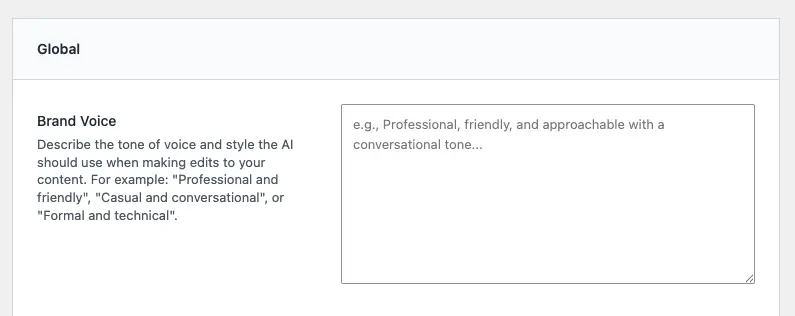
- Locate the Brand Voice field – You’ll see a large text area labeled “Brand Voice” with a description below it
The field includes:
- Label: “Brand Voice”
- Description: Explains that you should describe the tone and style the AI should use
- Placeholder text: Provides an example format
- Text area: 8 rows tall for entering your brand voice description
Setting Your Brand Voice
Basic Setup
- Click in the Brand Voice field – The text area is ready for input
- Enter your brand voice description – Write a clear description of your desired tone and style
- Save your settings – Click the “Save Settings” button at the bottom of the page
- Verify the save – A success message appears confirming your settings were saved
What to Include in Your Brand Voice Description
Effective brand voice descriptions include:
Tone descriptors:
- Professional, friendly, casual, formal, conversational, authoritative
- Examples: “Professional and friendly”, “Casual and conversational”, “Formal and technical”
Style characteristics:
- How you communicate (simple language, technical jargon, storytelling, direct)
- Examples: “Use simple, clear language”, “Write in a storytelling style”, “Be direct and concise”
Personality traits:
- What your brand represents (innovative, trustworthy, approachable, expert)
- Examples: “Approachable and expert”, “Innovative and forward-thinking”, “Trustworthy and reliable”
Language preferences:
- Specific words or phrases to use or avoid
- Examples: “Use ‘we’ instead of ‘the company'”, “Avoid technical jargon”, “Prefer active voice”
Audience considerations:
- Who you’re writing for (beginners, experts, general audience)
- Examples: “Write for a general audience”, “Assume technical knowledge”, “Explain concepts for beginners”
Example Brand Voice Descriptions
Professional Services:
Professional, friendly, and approachable with a conversational tone. Use clear, simple language that avoids jargon. Write in an authoritative yet accessible style that builds trust. Address readers directly using "you" and "your". Prefer active voice and concrete examples.
Tech Startup:
Innovative, energetic, and forward-thinking. Use modern, engaging language with a casual professional tone. Be concise and direct. Include specific examples and data when relevant. Write for a tech-savvy audience but avoid unnecessary technical jargon. Use active voice and action-oriented language.
Educational Content:
Clear, patient, and encouraging. Explain concepts step-by-step for beginners. Use simple language and avoid jargon. Include examples and analogies to make complex topics accessible. Write in a supportive, helpful tone that empowers readers to learn.
E-commerce/Retail:
Friendly, enthusiastic, and helpful. Use conversational language that feels personal. Focus on benefits and outcomes for the customer. Be warm and inviting while remaining professional. Use "you" to address customers directly. Keep descriptions concise but engaging.
B2B/Enterprise:
Professional, authoritative, and results-focused. Use clear, direct language that demonstrates expertise. Focus on business value and ROI. Write for decision-makers who appreciate efficiency and clarity. Use data and specific examples to support points. Maintain a confident, trustworthy tone.
How Brand Voice Affects AI Outputs
Your brand voice is automatically applied to all AI text generation and transformation features. Here’s how it works:
Text Transformations
When you use any text transformation action (Rewrite, Expand, Condense, Summarise, Professional, Personal) in:
- Block Editor paragraph blocks
- ACF text, textarea, or WYSIWYG fields
- WooCommerce product descriptions
The AI:
- Reads your brand voice description – Understands your tone and style preferences
- Applies it to the transformation – Rewrites, expands, or condenses content while maintaining your brand voice
- Maintains consistency – Ensures all transformed text matches your brand identity
Example: If your brand voice is “Professional and friendly”, a “Rewrite” action will produce text that’s both professional and friendly, not just a different version of the same content.
Title Generation
When generating titles in the document panel:
- The AI considers your brand voice for tone and style
- Titles match your brand’s personality
- Language choices align with your preferences
Example: A brand voice of “Casual and conversational” will generate titles that feel casual and conversational, while “Formal and technical” will produce more formal, technical titles.
Excerpt Generation
When generating excerpts:
- The tone matches your brand voice
- Style characteristics are applied
- Language preferences are respected
Example: An excerpt generated with a “Friendly and approachable” brand voice will feel warm and inviting, while “Authoritative and expert” will sound more professional and knowledgeable.
Interaction with Other Settings
Brand voice works alongside other settings:
Stop Words: Brand voice defines how you write; stop words define what you don’t write. Both are applied together.
Custom Instructions: Title and excerpt instructions provide specific guidance; brand voice provides the overall tone. They work together to create content that’s both on-brand and meets specific requirements.
Context Awareness: Brand voice is applied whether context is enabled or not. Context provides content information; brand voice provides style guidance.
Best Practices for Brand Voice Descriptions
Be Specific
Good: “Professional, friendly, and approachable with a conversational tone. Use clear, simple language and address readers directly using ‘you’.”
Less effective: “Professional and friendly”
Specific descriptions give the AI clear guidance on how to write, resulting in more consistent outputs.
Include Multiple Dimensions
Cover tone, style, personality, and language preferences:
Example:
Professional yet approachable tone. Use clear, simple language that avoids jargon. Write in a conversational style that feels personal but maintains authority. Address readers directly using "you" and "your". Prefer active voice and include concrete examples when relevant.
Match Your Actual Brand
Your brand voice description should reflect how you actually write, not how you wish you wrote. If your existing content is casual, your brand voice should be casual. If it’s formal, it should be formal.
Tip: Review your best-performing content and identify common characteristics. Use those as the basis for your brand voice description.
Keep It Concise but Complete
Aim for 2-4 sentences that cover the essentials:
- Tone (how it feels)
- Style (how it’s written)
- Key preferences (specific language choices)
Too short: Lacks guidance Too long: May confuse the AI or include conflicting instructions
Test and Refine
- Set an initial brand voice – Start with your best guess
- Generate some content – Use AI features to create or transform content
- Review the results – Check if outputs match your expectations
- Refine the description – Update based on what you observe
- Repeat – Continue refining until outputs consistently match your brand
Update When Your Brand Evolves
If your brand’s voice changes over time:
- Update your brand voice description to match
- Regenerate existing AI content if needed
- Ensure new content reflects the updated voice
Common Brand Voice Patterns
Professional Services
Characteristics: Professional, trustworthy, authoritative, clear Language: Direct, specific, benefit-focused Tone: Confident but not arrogant, helpful, expert
Example:
Professional, authoritative, and trustworthy. Use clear, direct language that demonstrates expertise. Focus on benefits and outcomes for clients. Write in a confident but approachable tone. Avoid jargon but don't oversimplify. Use active voice and specific examples.
Content Marketing
Characteristics: Engaging, informative, conversational, valuable Language: Accessible, clear, benefit-focused Tone: Friendly, helpful, expert
Example:
Engaging, conversational, and informative. Use clear, accessible language that feels personal. Focus on providing value and actionable insights. Write in a friendly, helpful tone that builds trust. Use "you" to address readers directly. Include examples and practical tips.
E-commerce
Characteristics: Friendly, enthusiastic, helpful, clear Language: Conversational, benefit-focused, simple Tone: Warm, inviting, supportive
Example:
Friendly, enthusiastic, and helpful. Use conversational language that feels personal and warm. Focus on benefits and how products solve problems. Write in an inviting, supportive tone. Keep descriptions clear and concise. Use "you" to address customers directly.
Technical Documentation
Characteristics: Clear, precise, authoritative, helpful Language: Technical but accessible, specific, accurate Tone: Professional, patient, expert
Example:
Clear, precise, and authoritative. Use technical language when appropriate but explain complex concepts simply. Be specific and accurate. Write in a professional, patient tone that helps readers understand. Use step-by-step instructions and include examples.
News/Journalism
Characteristics: Clear, objective, informative, concise Language: Direct, specific, factual Tone: Professional, neutral, authoritative
Example:
Clear, objective, and informative. Use direct, factual language. Be concise and specific. Write in a professional, neutral tone. Focus on accuracy and clarity. Use active voice and avoid unnecessary words. Present information without bias.
Troubleshooting
Brand Voice Not Being Applied
If AI-generated content doesn’t match your brand voice:
- Check your description – Ensure it’s clear and specific enough
- Verify settings are saved – Make sure you clicked “Save Settings” after entering your brand voice
- Review the description – It may need to be more specific or detailed
- Test with different actions – Try various text transformations to see if the issue is consistent
Conflicting Results
If some outputs match your brand voice but others don’t:
- Check for conflicting instructions – Ensure your brand voice description doesn’t contradict itself
- Review custom instructions – Title/excerpt instructions might be overriding brand voice in specific cases
- Test individual actions – Some actions (like “Professional” or “Personal”) may interact differently with brand voice
Too Generic or Too Specific
If outputs are too generic:
- Add more specific characteristics to your brand voice
- Include examples of preferred language or style
- Specify your target audience
If outputs are too rigid:
- Simplify your brand voice description
- Remove overly prescriptive language
- Focus on tone and style rather than exact wording
Brand Voice Conflicts with Action
Some text transformation actions have inherent tones:
- “Professional” action – Emphasizes professional tone
- “Personal” action – Emphasizes casual, personal tone
Your brand voice works with these actions, but the action’s tone takes precedence. If your brand voice is “Casual and friendly” but you use the “Professional” action, the output will be professional but may retain some friendly characteristics.
Tip: Choose actions that align with your brand voice for best results, or use “Rewrite” for maximum brand voice influence.
Next Steps
Now that you’ve configured your brand voice:
- Set up stop words – Learn about Using Stop Words to prevent unwanted terms
- Configure custom instructions – Set up Custom Title and Excerpt Instructions for more specific control
- Test your brand voice – Try text transformations in the Block Editor to see your brand voice in action
- Refine over time – Update your brand voice description as you learn what works best for your brand
Brand voice is a powerful tool for maintaining consistency across all AI-generated content. Take time to craft a description that accurately represents your brand, and don’t hesitate to refine it based on results.