
A useful vehicle configurator should do more than let someone change colours and wheels. For a bespoke automotive brand, it should turn complex build options into a clear sequence, prevent incompatible choices, capture structured customer preferences and hand a qualified configuration into the sales process. If needed, that same data can help support quoting, invoicing, workshop updates and even delivery workflows.
A configurator is part product experience, part qualification tool
For a mass-market manufacturer, a configurator often helps a buyer compare trims and visualise a production vehicle. A bespoke builder has a different problem. The customer may be commissioning a one-off restoration or restomod with decisions from donor vehicle, engine, drivetrain, suspension, exterior finish, wheels, interior, materials, technology and optional equipment. The list could go on!
The configurator therefore needs to make expertise feel accessible without reducing craftsmanship to a generic (and boring) ecommerce options list.
What a bespoke vehicle configurator should do
| Capability | Customer value | Business value |
| Guided option sequence | Makes a complex commission easier to understand | Creates a consistent qualification process |
| Rules and dependencies | Prevents impossible or incompatible selections | Reduces clarification and quoting errors |
| Visual feedback | Helps the customer imagine the finished vehicle | Increases emotional engagement |
| Structured configuration summary | Shows exactly what has been selected | Creates cleaner data for sales follow-up |
| Lead capture | Lets the customer save or submit a build | Turns exploration into an identifiable opportunity |
| Pricing / indicative pricing where appropriate | Sets expectations | Can reduce unsuitable enquiries |
| CRM / sales handoff | Avoids re-keying customer choices | Connects marketing experience to operations |
| Persistent build data | Allows a configuration to continue beyond the first session | Can become the starting point for quoting or project management |
1. Start with the real build process, not the interface
Before designing screens, map how the builder actually specs a vehicle. Which decisions have to happen first? Which choices affect later choices? Which options are mutually exclusive? Which selections change price or lead time? Which details are purely aesthetic and which have engineering consequences? Again, that list can go on, and on!
A good configurator offers enough of that expertise to help guide a prospective customer without pretending to replace the consultation that makes a bespoke commission valuable.
2. Separate option categories from option logic
The visible categories are the easy part. The difficult part is how options within those hang together underneath them. An engine choice may require a transmission, suspension or brake package; a body style may rule out another option; some combinations may be possible but require a manual quote. Generally speaking you’re going to need:
- Base vehicle or series
- Engine and drivetrain
- Chassis, suspension and braking
- Exterior colour and finish
- Wheels and tyres
- Interior layout, trim and materials
- Technology and convenience
- Accessories and overland equipment
- Special requests that require consultation
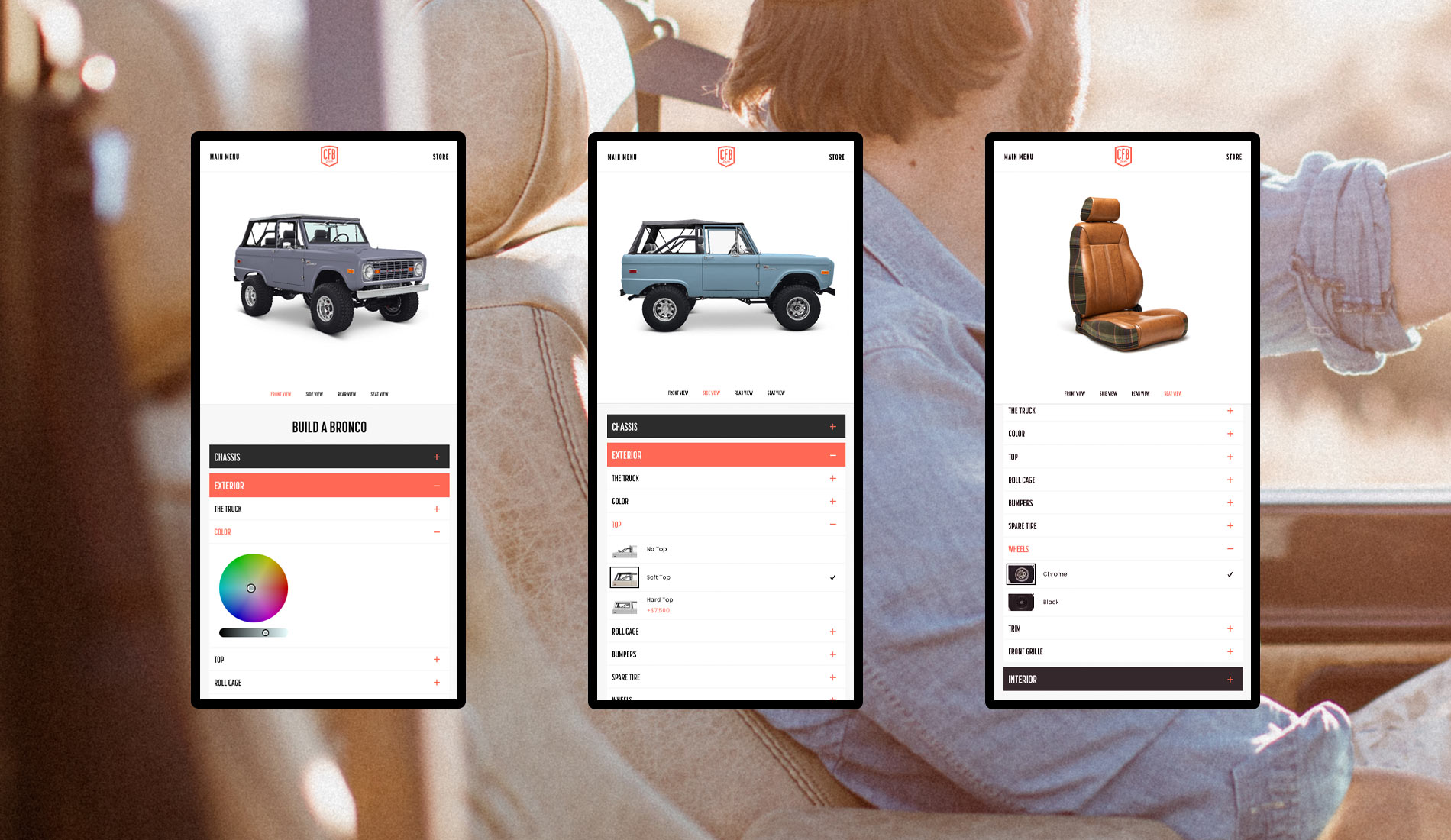
3. Decide how much visualisation genuinely adds
A configurator can range from illustrated option cards and photography to layered 2D imagery or full 3D rendering. Chucking in more visual complexity is not automatically better. The right level depends on the number of combinations, available assets, required realism, budget, and how often the product changes.
| Visual approach | Best when | Trade-off |
| Photography / option cards | Craftsmanship and real-world examples matter most | Less instant visual combination feedback |
| Layered 2D renders | A controlled set of visual options can be composited | Requires consistent asset production |
| Interactive 3D | The product and option set justify immersive exploration | Higher asset, development and performance complexity |
| Hybrid | Real builds establish trust; renders explain configurable choices | Needs disciplined content and asset management |
4. Treat lead capture as part of the experience
Fhoke’s Classic Ford Broncos project provided a useful first-hand example. The Bronco Builder was added as the site evolved, designed to capture the user’s imagination while allowing CFB to capture anyone interested in building one of their Broncos. The configurator wasn’t just for entertainment (although it was pretty cool), it could turn product exploration into a sale!
A submitted configuration should ideally give the sales team more context than a generic ‘contact us’ form: selected model, options, contact details, notes and a configuration reference or summary.
5. Decide whether pricing belongs in the configurator
Transparent pricing can be useful when option costs are stable and the commercial model supports it. But bespoke builders may have variable donor costs, engineering dependencies, material changes or labour requirements that make a definitive live price misleading.
In that case, show an indicative figure, a ‘from’ position, or no price at all and use the configuration as the basis for a qualified quotation. Accuracy is more important than imitating a mass-market OEM configurator.
6. Choose the technical architecture around the workflow
| Architecture | Good fit | Typical role |
| WordPress + custom front-end functionality | Marketing-led automotive site with a tightly integrated configurator | Content, builds, brand storytelling, lead generation |
| WordPress + bespoke API/service | Configurator logic or data needs more separation | CMS experience plus specialist application layer |
| Laravel / bespoke web application | Complex rules, accounts, quoting or operational workflows | Configuration, data, workflow and business logic |
| CRM integration | Sales team needs structured leads in an existing system | Customer/configuration handoff and follow-up |
Fhoke’s automotive services combines WordPress, Shopify, WooCommerce and Laravel experience. We can build bespoke systems that extend from those first vehicle choices into invoicing, workshop build updates, and the final customer delivery.
7. Design the handoff from marketing into operations
The most valuable configurator data happens after a customer submits those choices. Decide who receives it, where it is stored, whether it creates a CRM opportunity, how revisions are handled, and whether an approved spec becomes the starting point for a build project.
For more sophisticated bespoke builders, the customer-facing configurator and internal build-management system can share that data without being the same interface.
8. Plan for editors and option changes
Automotive specs evolve. Paint colours change, components become unavailable, new packages launch and pricing moves. If every option change requires a developers hand in it, the tool can become expensive to maintain. Decide which data should be editable by the client and which rules should remain developer-controlled.
9. Measure more than completions
- Configurator starts and completion rate
- Drop-off by step
- Most-selected options and combinations
- Save/share behaviour where available
- Lead submission rate
- Qualified-lead rate from configurator submissions
- Quote or consultation progression
- Mobile vs desktop behaviour
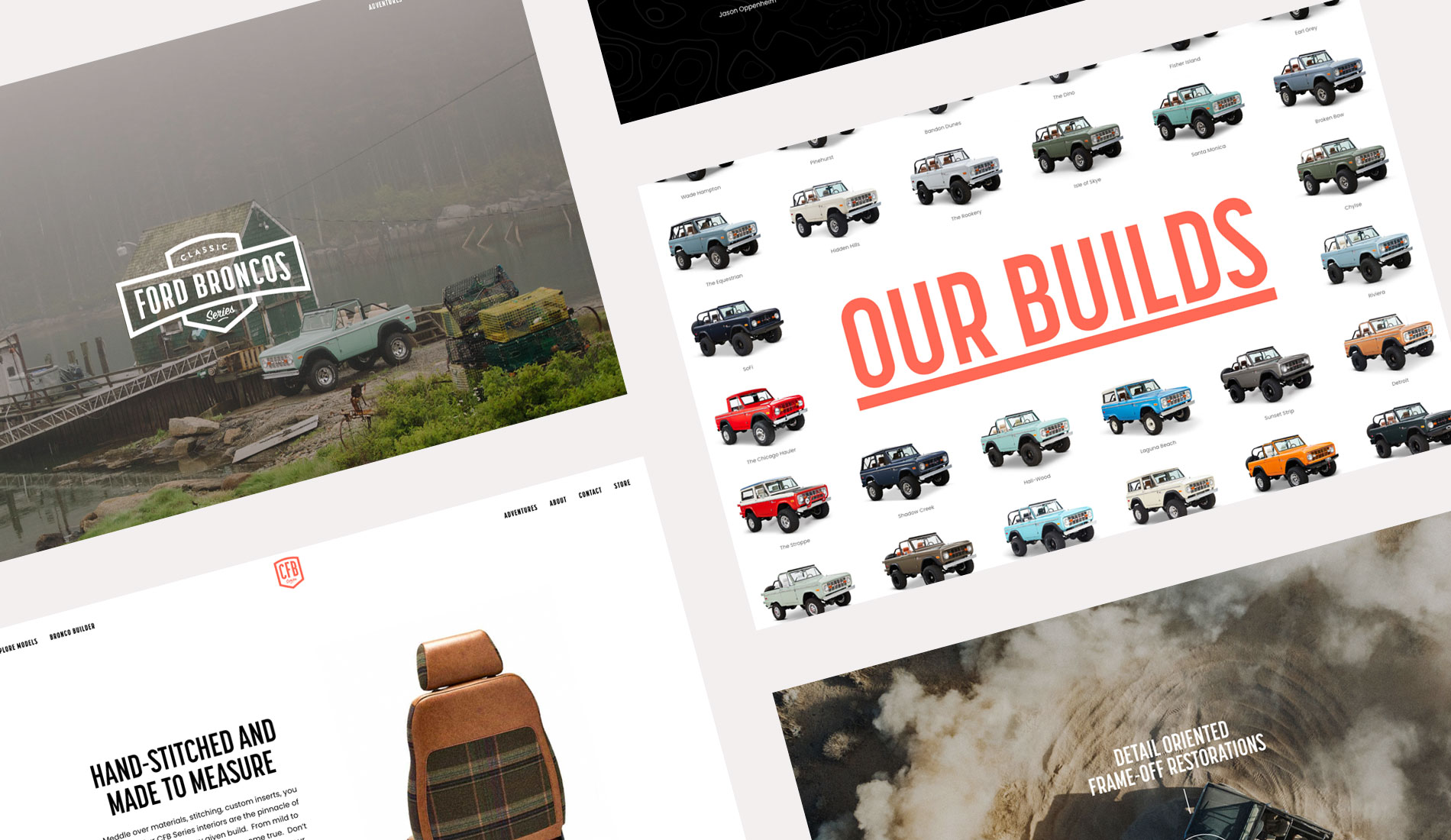
Classic Ford Broncos
While the brand was sold on in early 2026, Fhoke had been involved with Classic Ford Broncos since 2016. As the business and website changed, a Bronco Builder was added to help customers explore customisation options while capturing user data. The wider site remained a bespoke WordPress theme, allowing the configurator to sit inside the same brand and content journey rather than feeling like an unrelated third-party widget.
Beyond a marketing configurator, we also built a custom system to support CFB with the journey from initial option selection through invoicing, workshop updates and final delivery. For businesses that need that level of control, a Laravel or other bespoke app layer can be better than forcing day-to-day operations into a standard CMS. So it’s importantant to think about where the boundary sits: WordPress can remain the brand/content platform while a bespoke app could handle workflows that are genuinely application-like.
Fhoke’s view
A vehicle configurator should earn its complexity. For a bespoke builder, its first job is to make a complicated product easier and more exciting to spec; its second is to give the sales team better information. Only extend it into quoting, customer accounts or workshop management when those workflows create genuine value to the business. Start with the build process, then design the technology around it.
Beyond a vehicle configurator, we can also help define what a custom car builder or restomod website should include.
Vehicle configurator planning checklist
- Map the real specification process with sales, engineering and workshop teams.
- Define option dependencies and incompatible combinations before UI design.
- Choose the minimum visualisation level that communicates the product convincingly.
- Decide whether pricing is fixed, indicative or quotation-only.
- Define what data is captured and where it goes after submission.
- Give editors control over options that change regularly.
- Plan how saved configurations and revisions will be identified.
- Design mobile interactions for complex option sets.
- Instrument analytics by step, not just final submission.
- Keep the marketing configurator and operational system separate unless there is a clear reason to connect them.


