A recruitment website in 2026 should be more than a corporate site with a jobs board. It needs to work as a candidate acquisition platform, an employer sales tool, a content and research hub, and a usable front end for the recruitment technology behind the business.
The essential recruitment website stack
| Capability | What good looks like |
|---|---|
| Candidate journey | Clear route to relevant jobs, specialisms and consultants. |
| Employer journey | Services, expertise, proof and a clear path to start a hiring conversation. |
| Job search | Fast, relevant filters based on candidate behaviour rather than internal CRM language. |
| Integration | Jobs and applications synchronise with the recruitment stack without creating duplicate admin. |
| Sector content | Useful landing pages combining expertise, jobs, people, evidence and insights. |
| Proof | Client outcomes, case studies, testimonials, market data and demonstrable experience. |
| CMS | Internal teams can publish and change content without developer dependence. |
| Measurement | Analytics show which pages, campaigns and journeys lead to applications and enquiries. |
1. Start with people, not the sitemap
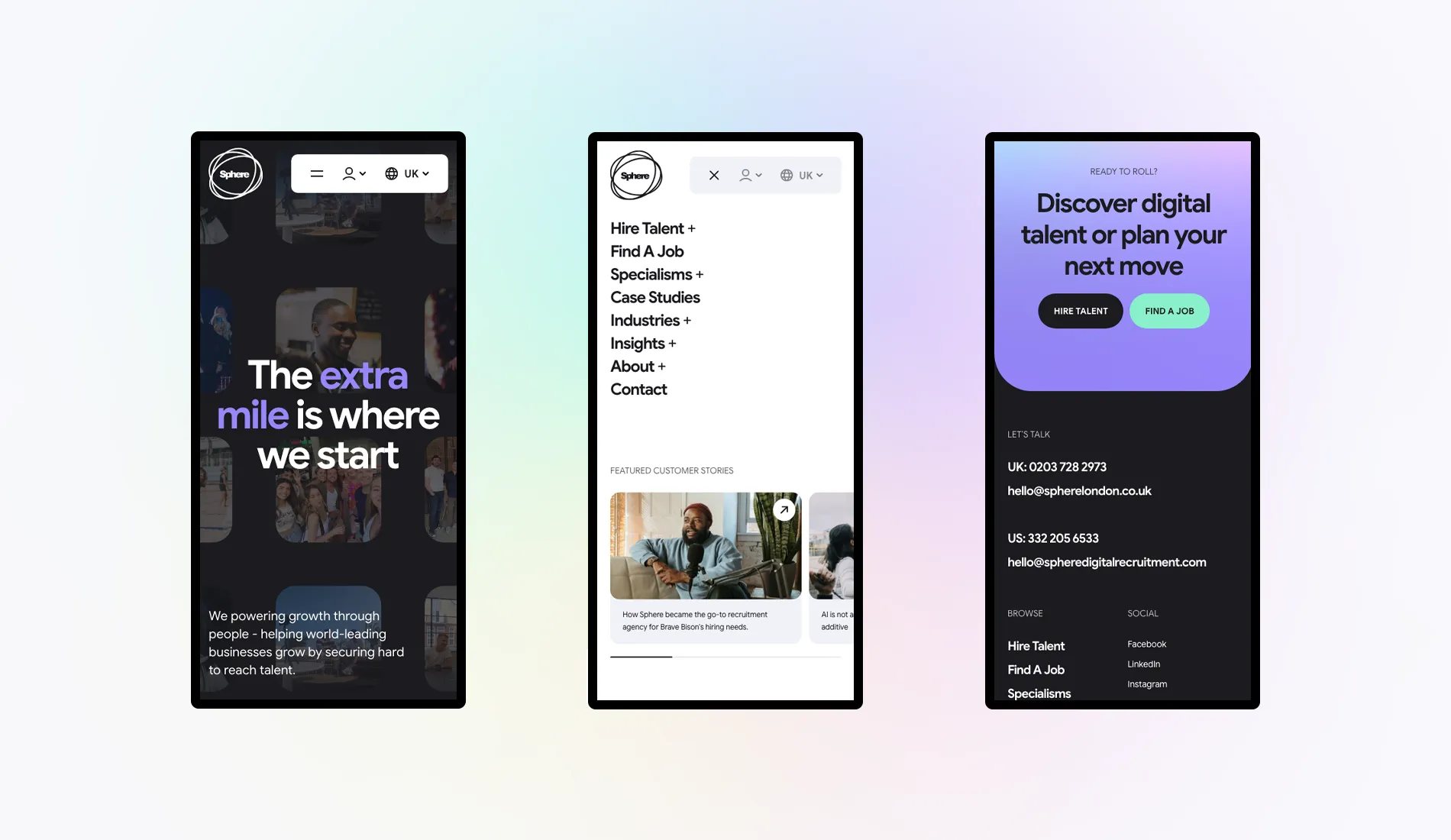
Fhoke’s work with Sphere Digital Recruitment reinforced a simple principle: somebody looking for their next role has a fundamentally different goal from a business trying to build a team. The structure should recognise that immediately. ‘Find a Job’ and ‘Hire Talent’ are not decorative calls to action; they are separate journeys.
2. Search should use the candidate’s language
Do not expose every internal field in the recruitment database merely because it exists. A user should not need to understand how your consultants classify vacancies in order to find one. Keyword, location, discipline, working pattern and job type are useful when they reflect real behaviour. Twenty overlapping filters are not automatically better than six good ones.
3. Integrate recruitment technology properly
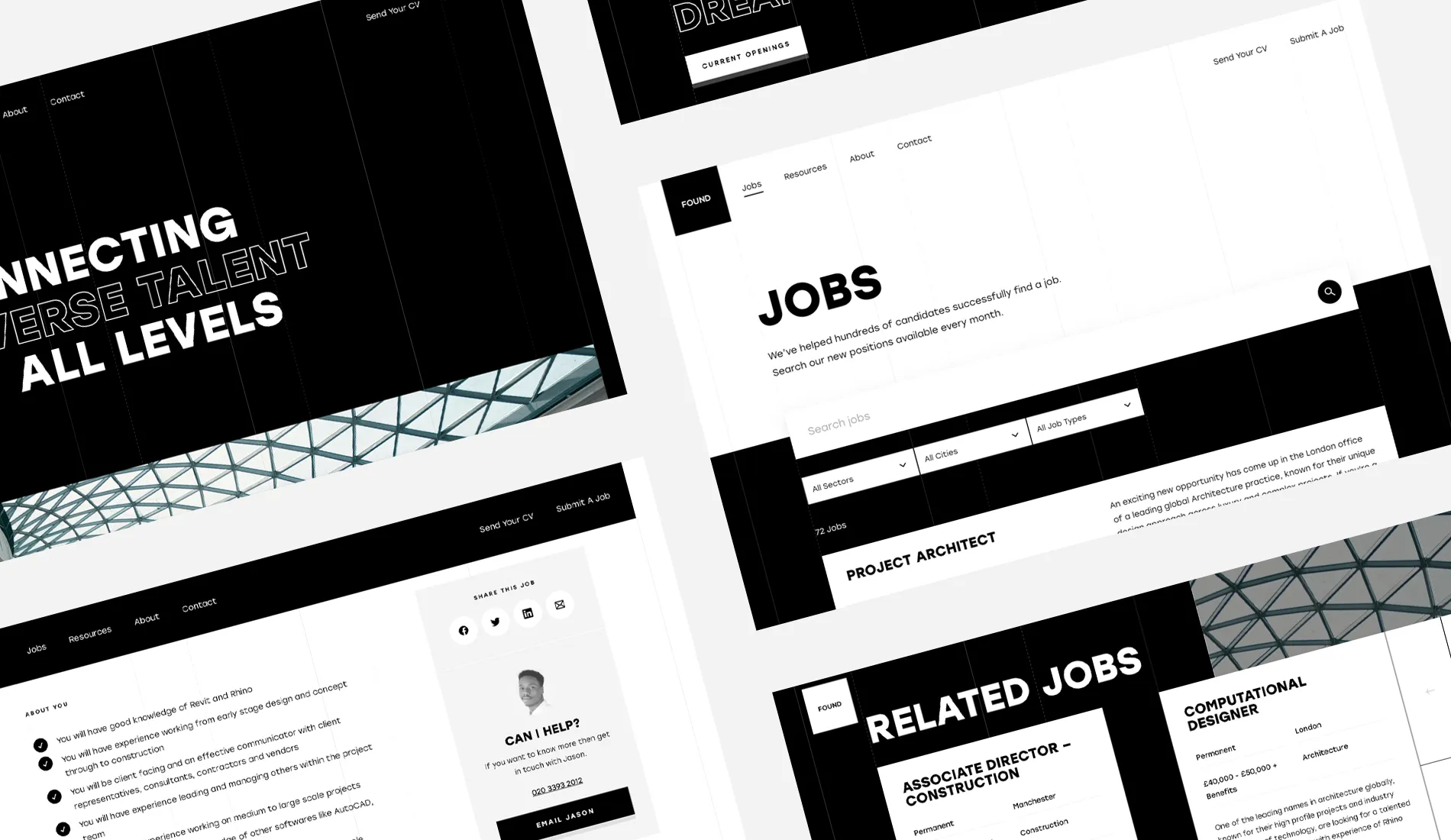
Salt Recruitment uses Broadbean to feed jobs into the website and return applications. Annapurna has used Bullhorn and, later, Broadbean via JobRelay. FOUND Careers uses custom WordPress post types and forms. Those projects demonstrate that there is no single correct recruitment stack: the public website should be designed around the user and then integrated with the systems the business uses.
4. Build sector pages that prove expertise
A sector page should do more than claim expertise. Combine relevant consultants, live vacancies, market knowledge, case studies, hiring services and original insight. That creates a page which is useful to a prospective client, useful to a candidate and far easier for search or AI systems to understand.
5. Put evidence near the claim
Recruitment is full of generic claims: specialist, global, people-first, trusted, expert. Evidence makes those claims useful. Show placements, case studies, client feedback, salary data, research, locations, years of experience and specialist teams where the information can be substantiated.
6. Design for a marketing team that has to use it every week
A component content block system should help with the creation of landing pages, the publication of research, and the evolution of a sector area without redesigning the website every time. Fhoke’s work on Sphere specifically highlights the value of a considered component system for a large recruitment website, while Salt’s centralised WordPress build reduced the management burden created by fourteen separate regional sites.
7. Treat international growth as a content problem as well as a technical one
Regional jobs, contact details, specialist teams and local content may differ while the brand remains one organisation. A scalable platform should allow that variation without forcing every market into a separate website.
Fhoke’s view
The best question is no longer ‘does our recruitment website look dated?’ It is ‘is it doing enough?’ A modern recruitment website design and build should reduce friction for candidates, make expertise obvious to employers, give the marketing team control and leave room for the next service, region or hiring model. Even if you’re not redesigning your website, we offer some advice on rethinking what a recruitment website should be.
A 30-second test
- Can a candidate reach relevant jobs quickly?
- Can an employer understand where you specialise?
- Is there evidence that supports the claims you make?
- Can the internal team publish without asking a developer?
- Can the platform absorb a new region or service without another redesign?


