
One month after bringing The Studio Dispatch back, we’ve managed to do another one. Nobody touch anything.
September took us from reputation and professional training to global recruitment. Three launches, three very different audiences and one familiar challenge: making complex businesses feel clear, confident and easy to use.
Here’s what left the studio this month—plus five shifts in AI that are worth keeping an eye on.
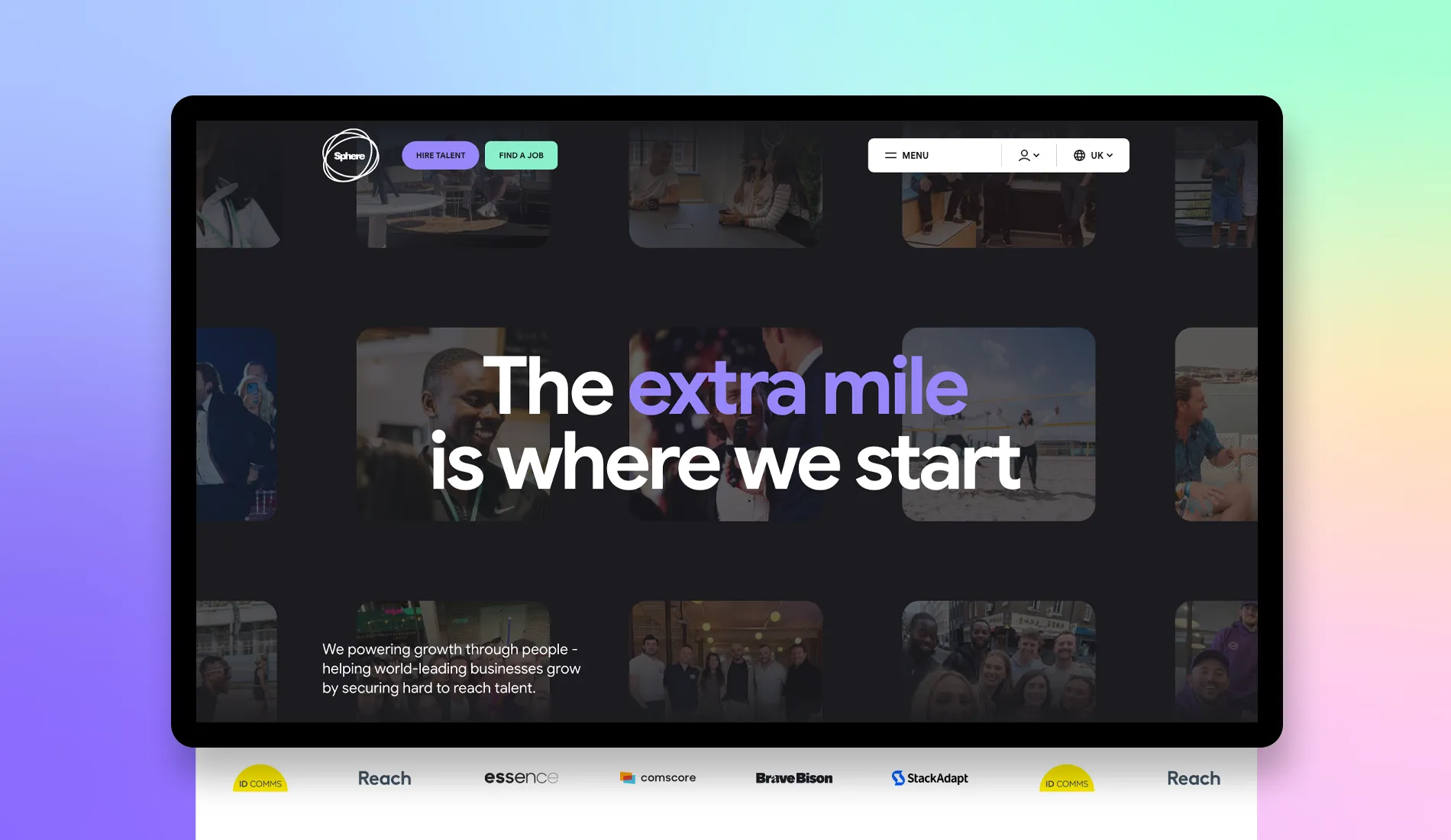
Globally connected. Digitally joined up.
Sphere has spent nearly two decades connecting ambitious businesses with talent across technology, media, marketing, consumer and creative markets. With teams and opportunities spanning the UK, US, Europe and South Africa, its website needed to communicate serious scale without losing the personal focus that defines the business.
We created a bold visual direction and a clearer experience built around two immediate needs: Hire Talent and Find a Job. Strong typography, confident messaging and an energetic colour palette give Sphere’s new recruitment website a distinct identity, while careful content hierarchy keeps a large, international offer from feeling like hard work.
A bespoke WordPress build brings live vacancies into the site via Broadbean, with filtering, candidate accounts and saved jobs forming part of the same experience rather than sending people off to a job board that looks as though it wandered in from 2012. Reusable components also give Sphere’s team the flexibility to manage services, specialisms, industries, insights and regional content from one scalable platform.
We also unpacked what the project taught us about modern recruitment websites: start with people rather than the sitemap, make the technology almost invisible, and remember that the website has to sell expertise as well as vacancies.
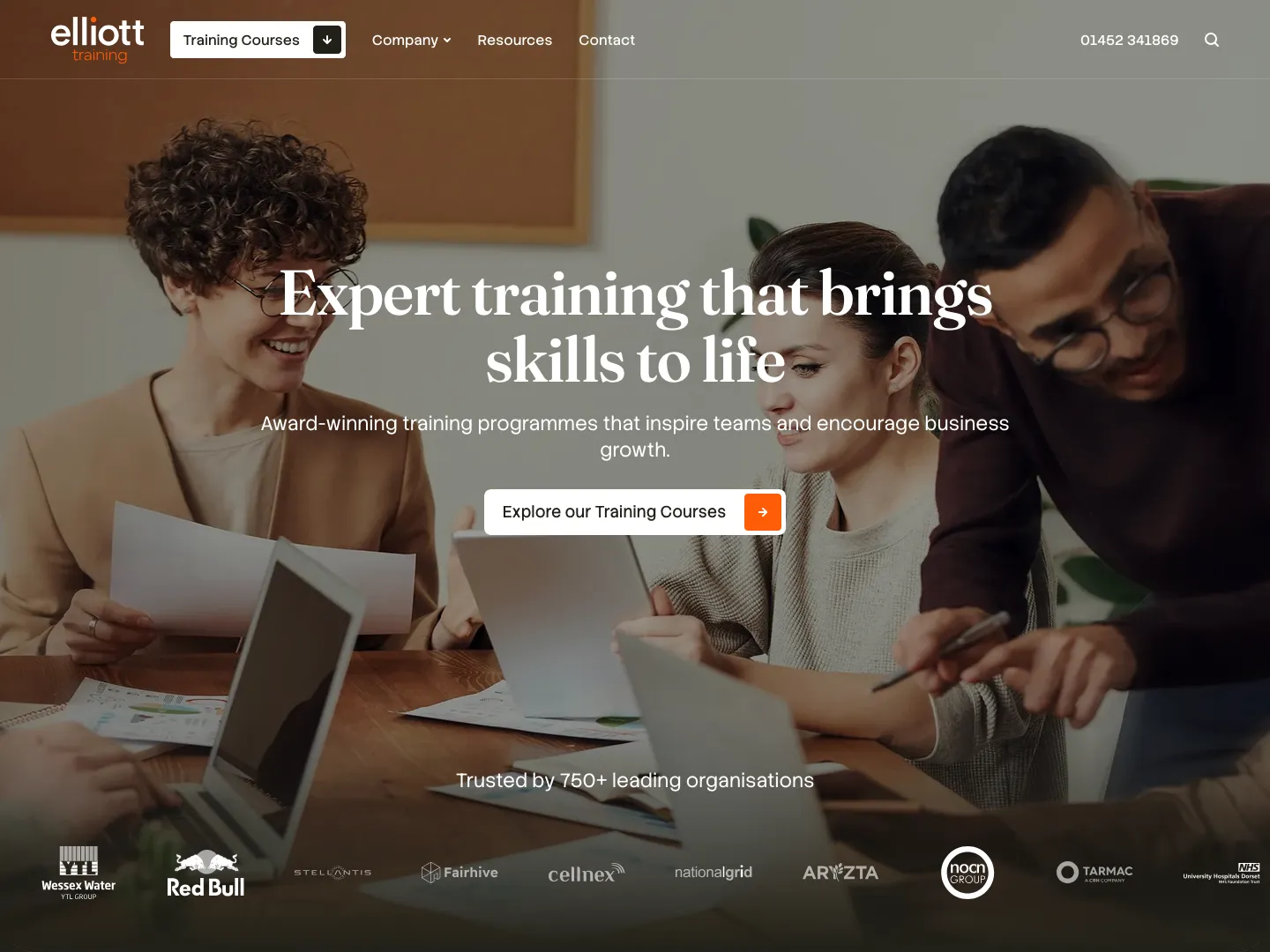
Thirty years of training. One much smarter website.
Elliott Training has helped people and businesses grow since 1996. Over that time, its course catalogue, client base and expertise had expanded considerably. The website had not been quite so enthusiastic about keeping up.
Rather than discard three decades of recognition, we refined the existing logomark into a cleaner, more confident identity. That evolution shaped a bright, approachable website with clearer routes into leadership, personal effectiveness, customer service, project management and corporate IT training.
Behind it sits a bespoke WordPress theme built around the way the business actually works. Flexible content blocks make the growing offer easier for the team to manage, while custom course filtering helps visitors narrow more than 100 courses into something useful without requiring a qualification in navigation first.
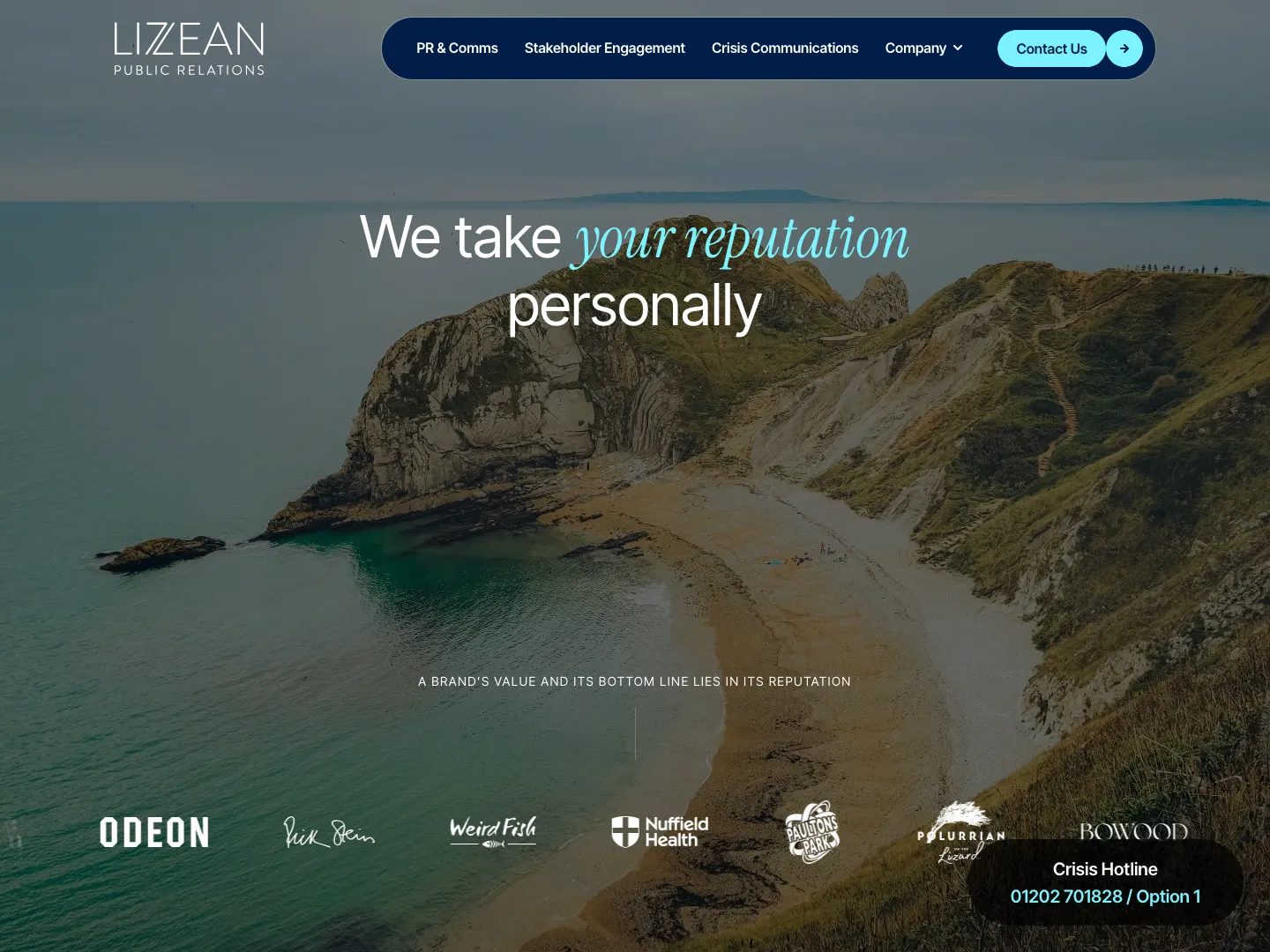
A reputation worth protecting
Liz Lean PR has been building, growing and protecting reputations since 1998. From its original beachside base in Sandbanks to a second team in London, the family-run agency has spent close to three decades proving that good PR is about far more than making noise.
The new website puts that thinking front and centre. Clear journeys through PR and communications, stakeholder engagement and crisis communications make a broad offer easier to understand, while case studies, client results and the people behind the work give every claim something solid to stand on.
We brought the agency’s strategic approach and very human personality together in a website that feels experienced without feeling corporate. It gives the team room to share its thinking, demonstrate its impact and keep evolving the story. Reputations take years to build; fortunately, the website didn’t.
Meanwhile, AI picked up the pace
Last month it was agents, AI search and new transparency rules. September found five more ways to move the conversation on:
- Frontier capability is getting cheaper to run. Bigger benchmark scores still attract the headlines, but the economics may matter more. Anthropic says Claude Sonnet 5.5 runs more than 30% faster than its predecessor and costs up to 30% less for most work. As capable models become quicker and more efficient, many AI ideas that looked too expensive at scale start becoming commercially realistic. Source: Anthropic’s Claude Sonnet 5.5 announcement.
- Voice is becoming a way to operate software. Google’s latest speech-to-speech models can reason through multi-step requests and now work across Search, Gemini and Workspace, including Gmail, Docs and Keep. Talking to a computer is moving beyond dictation or a novelty conversation; it is becoming a practical way to find information and get work done. Source: Google’s September AI roundup.
- AI is beginning to contribute original scientific discoveries. Anthropic reported that a group of Claude agents identified a previously uncharacterised enzyme system associated with unusual DNA repeats, which human scientists then analysed and tested in the lab. The function is still being investigated, but the shift matters: AI is moving from summarising existing research towards helping decide what researchers should examine next. Source: Anthropic’s life sciences research.
- Enterprise AI is moving beyond the pilot stage. Microsoft says it has deployed more than 100 purpose-built agents across parts of its cloud supply chain, cutting cycle times by up to 75% in selected workflows. The more useful lesson is how it got there: simplify the process first, give every agent reliable shared data, then define exactly where people review, approve and intervene. Adding AI to a broken workflow still leaves a broken workflow—only faster. Source: Microsoft’s AI transformation report.
- AI safety is becoming an independent audit discipline. Anthropic and Accenture announced a partnership that will place external evaluators inside the development process, with access to models as they are trained and deployed. Red-teaming and safety testing are moving closer to continuous, independent scrutiny rather than a one-off check at the end. For systems taking on more consequential work, “trust us” was never going to be a particularly durable framework. Source: Anthropic and Accenture’s embedded evaluation partnership.
The thread running through all five is maturity. AI is becoming cheaper, more natural to use and more deeply embedded in real work, while the expectations around evidence, oversight and accountability are getting tougher.
That was September: three launches, several satisfyingly complicated problems solved and a second consecutive Studio Dispatch. At this rate, we may have to stop joking about the next one arriving in 2029.
Have an ambitious brand, website, online store or digital product in mind? Let’s talk.


